
Georges-Antoine Rochegrosse (1859 – 1938)
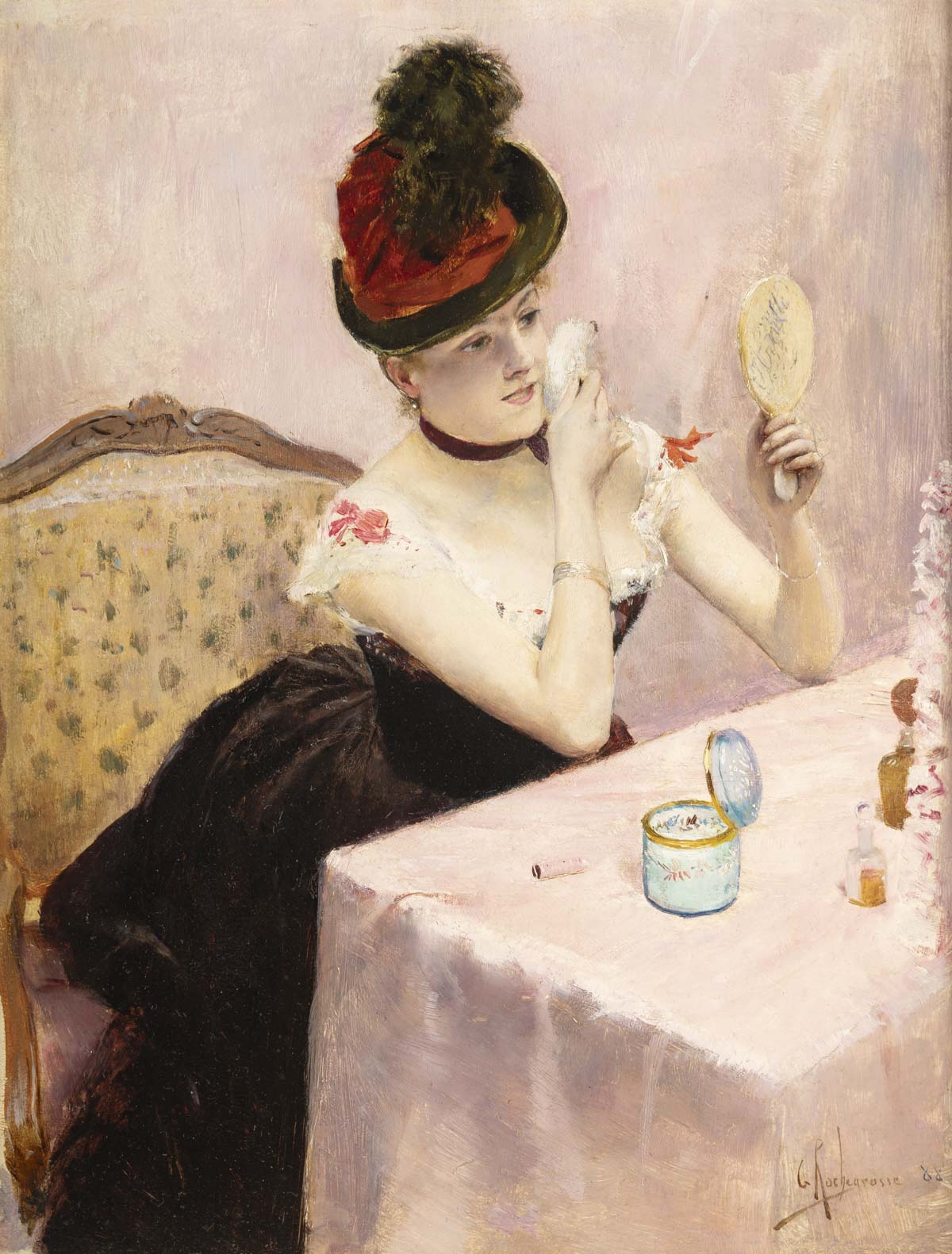
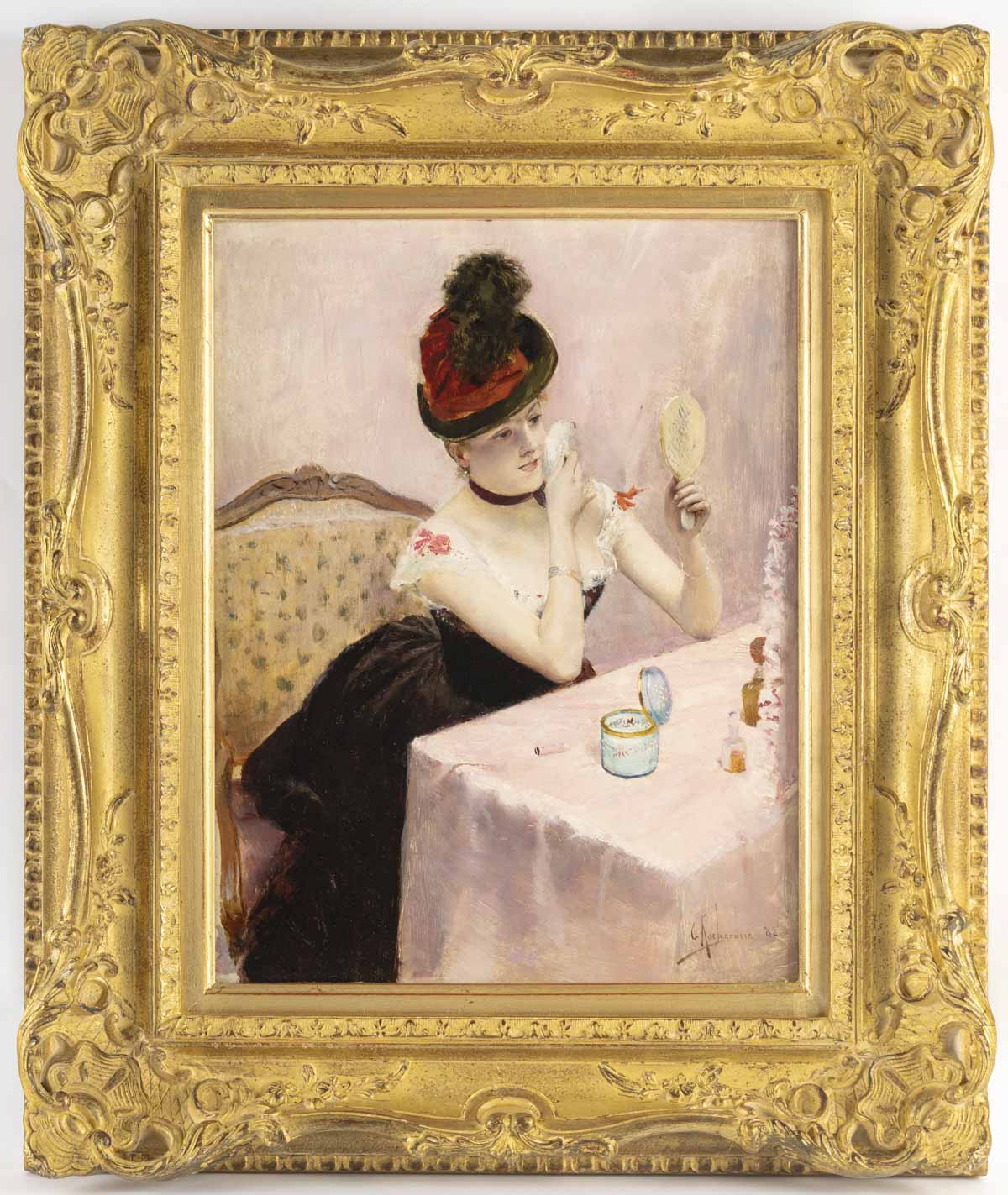
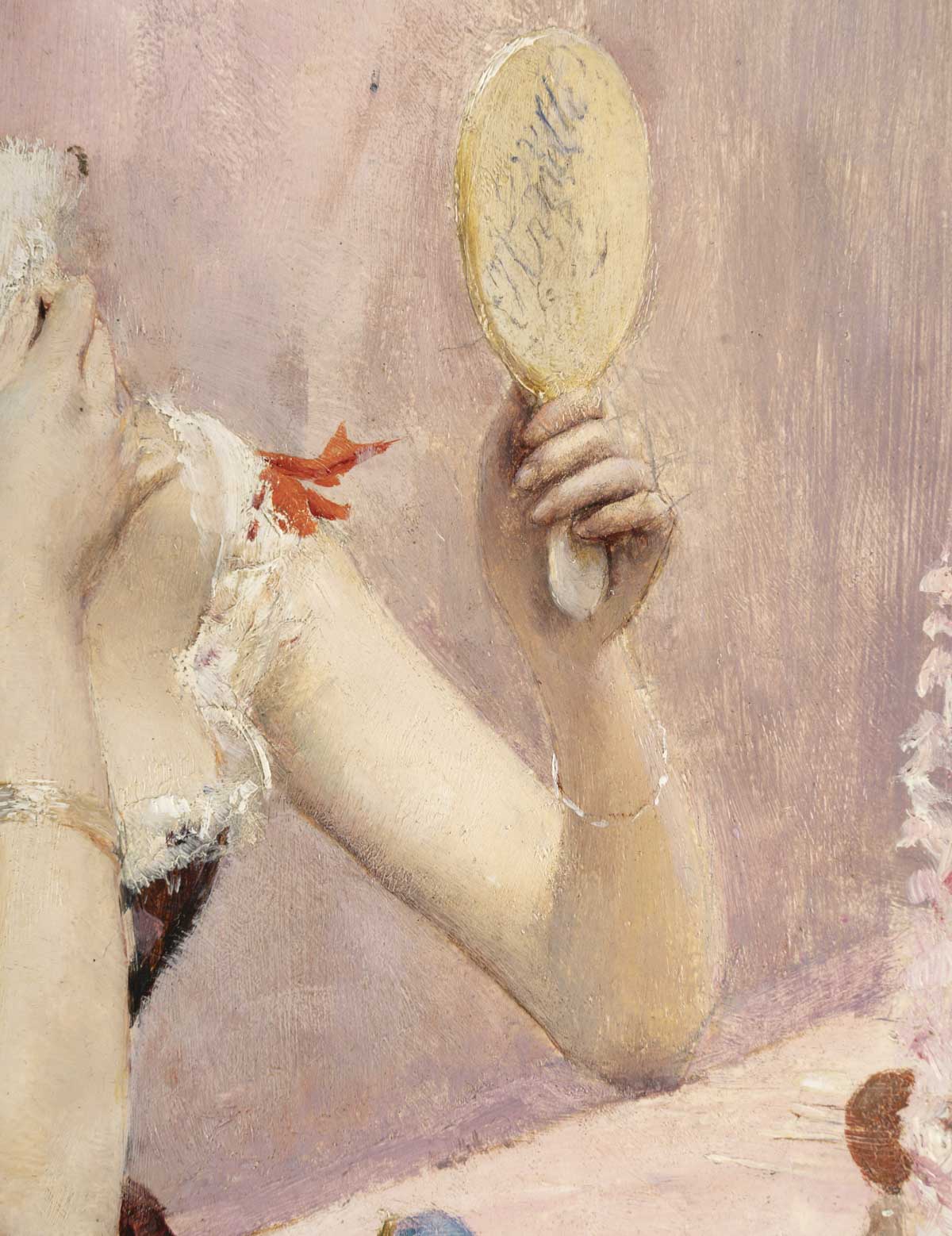
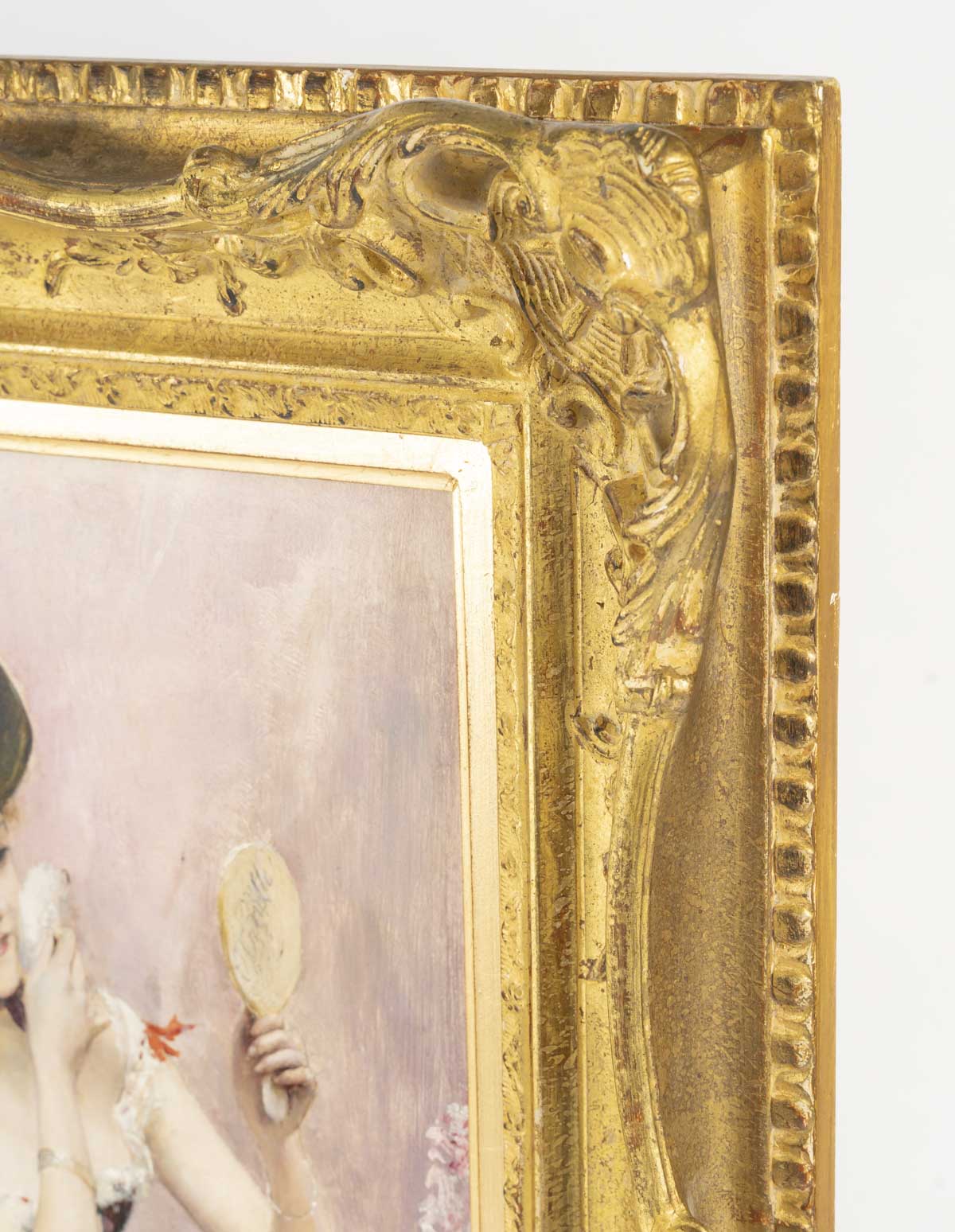
An intimate, feminine work, dated 1888, depicting a woman powdering her face by Georges-Antoine Rochegrosse, accentuated by the dominant pink color of the painting.
Oil on panel
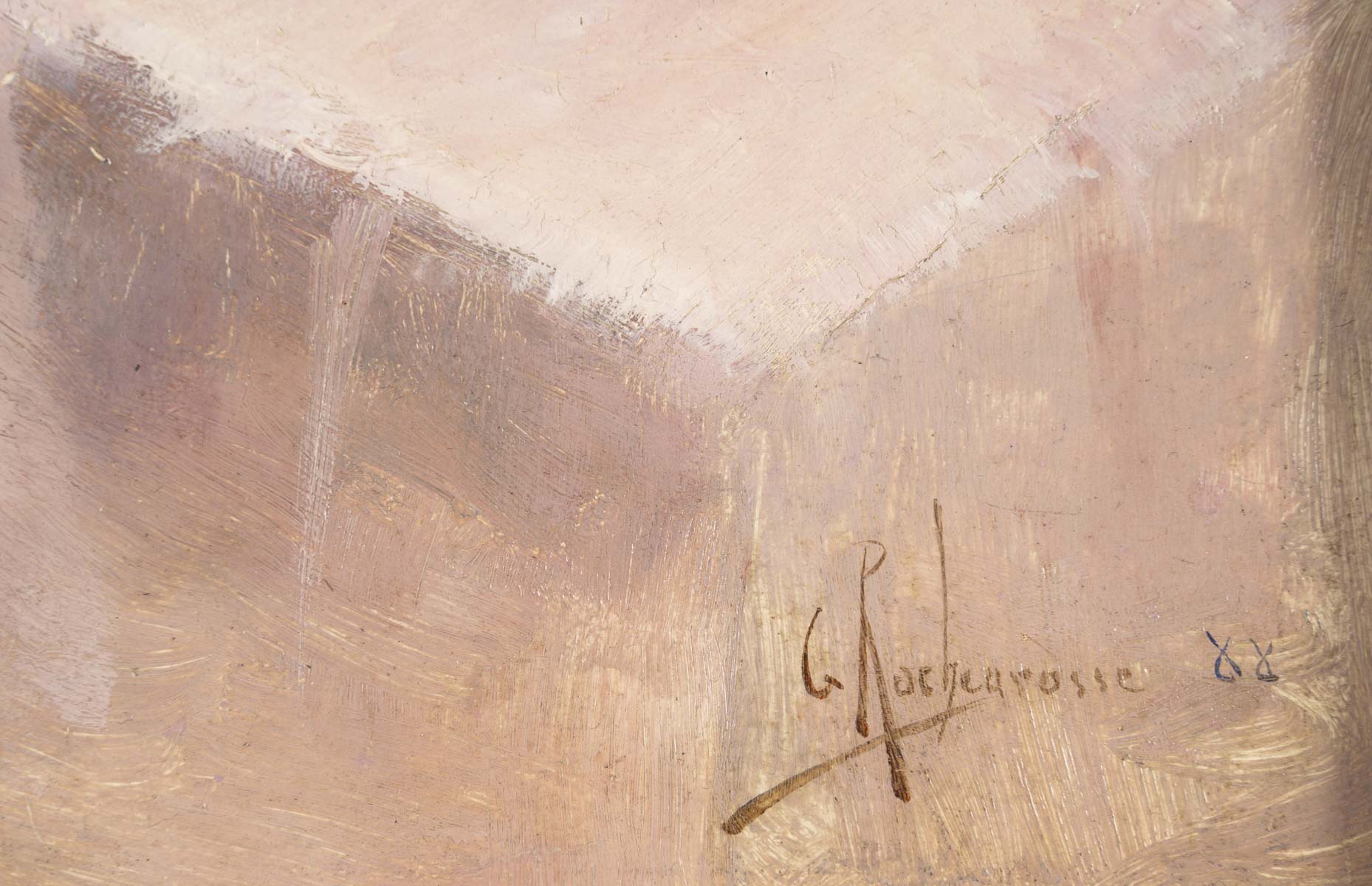
Signed and dated 1888 lower right
Dimensions: 35 x 27 cm
with frame: 51 x 43 cm
Price: 5500 euro
Georges-Antoine Rochegrosse, a talented painter.
An engaging artist of great imagination, he was sensitive to the great currents of the 19th century, from Orientalism to Symbolism to Japonism. Critically acclaimed and appreciated by the general public, he enjoyed international recognition during his lifetime.
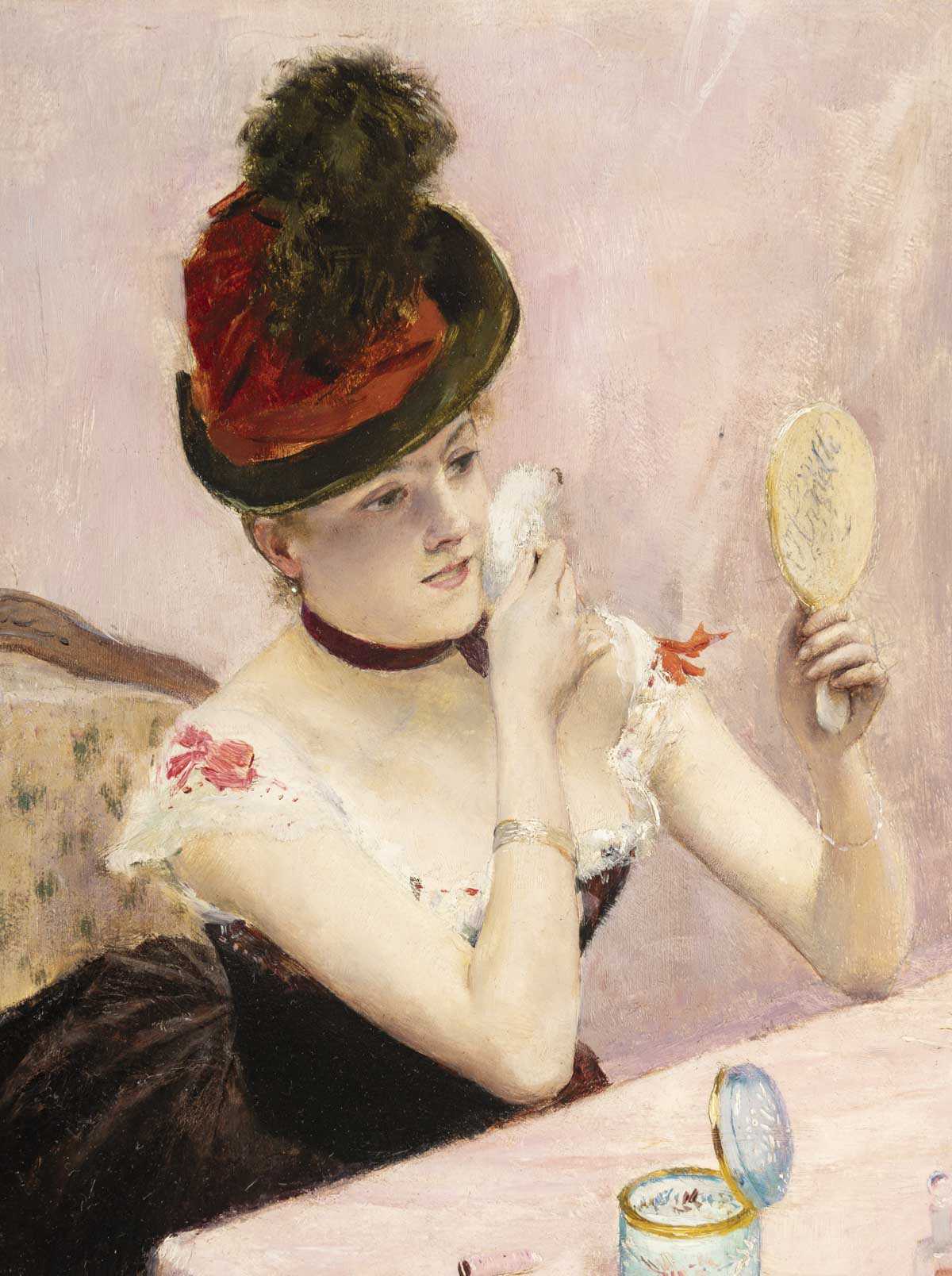
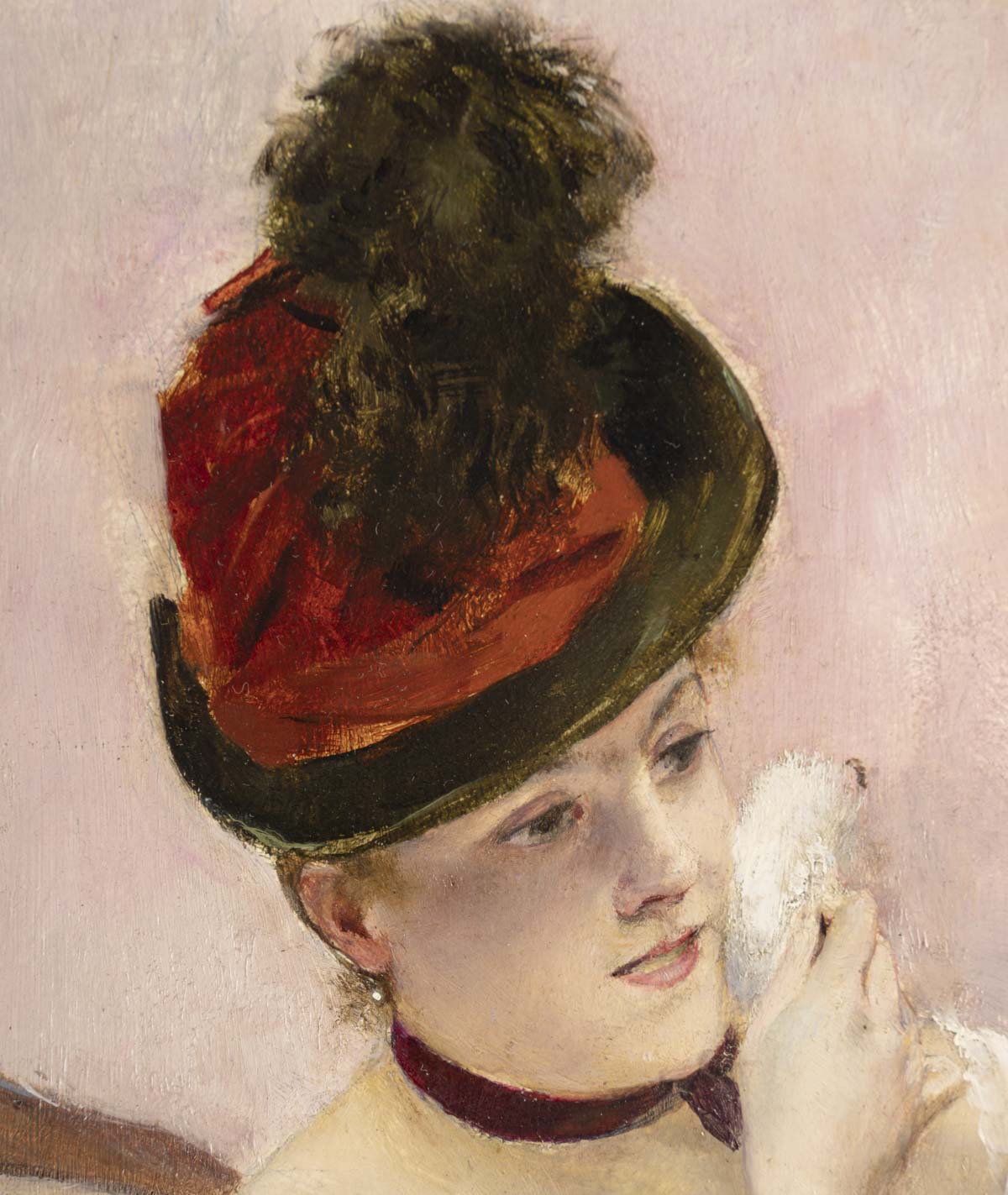
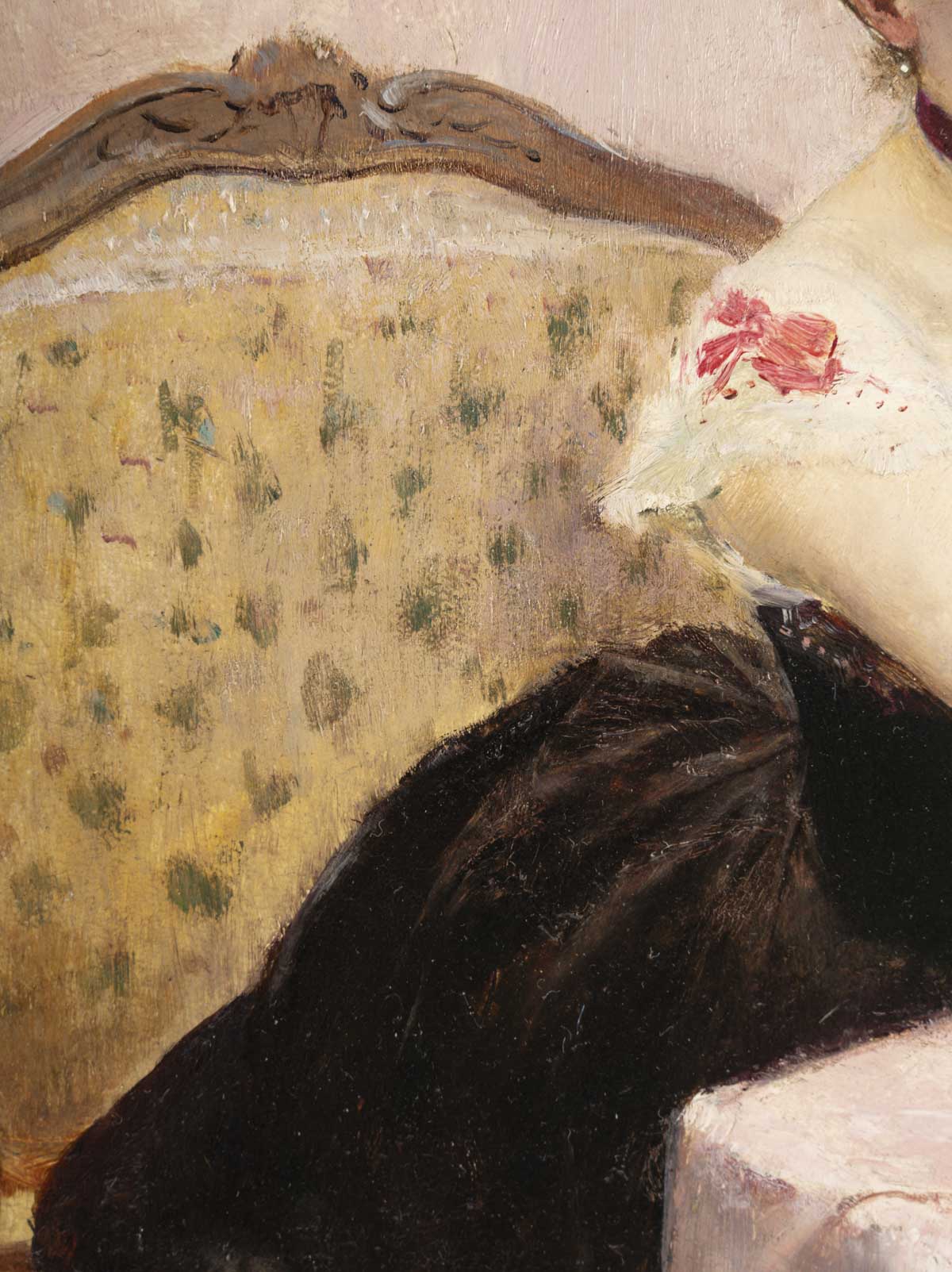
There is a contrast here between the finesse of the brushstrokes and the precision of the rendering of the face, and the more sweeping, impressionistic brushstrokes for her outfit and the décor.
Her colors show a search for preciousness and refinement. Here, the black of the hat and skirt contrast nicely with the pink of the background.
The theme of “Women at the Toilet”, a recurring theme among painters.
Painters have left innumerable images of women captured in their intimacy, particularly in their toilette.
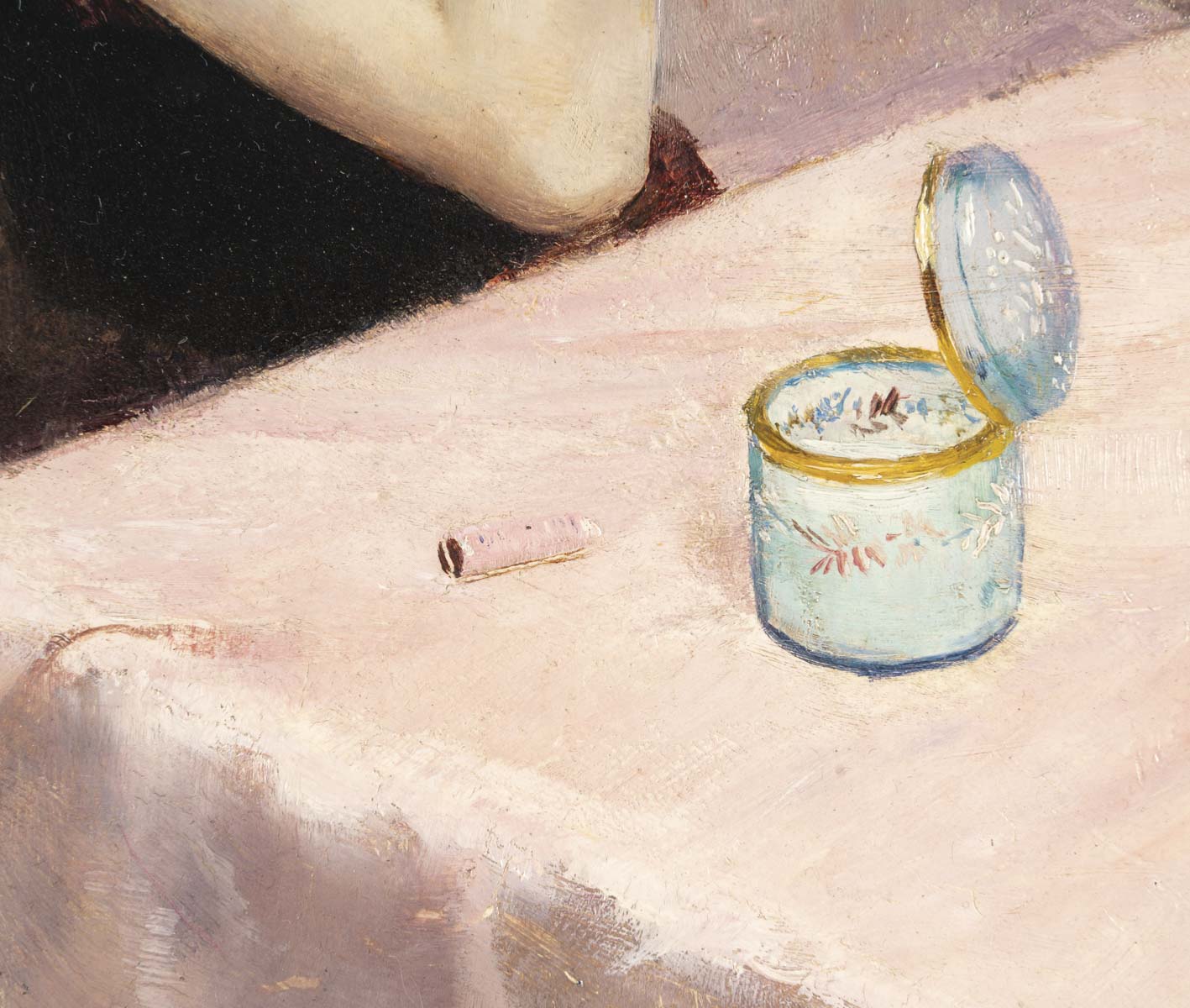
Here, a young, scantily clad woman, seated in front of a dressing table, applies powder to her cheeks while looking in the mirror. The painter is probably depicting a music-hall dancer or singer in her dressing room, with its pink décor, doing a few make-up touch-ups before going on stage.
Biography
Georges-Antoine Rochegrosse, who lived in Versailles and died in El Biar (Algeria), was a French painter, decorator and illustrator.
He lost his father at the age of 15. His mother remarried the poet Théodore de Banville, and he became her adopted son. This gave him the opportunity to socialize with the artists and men of letters his stepfather welcomed into his home: Paul Verlaine, Stéphane Mallarmé, Arthur Rimbaud, Victor Hugo and Gustave Flaubert.
He began his training as a painter with Alfred Dehodencq, then entered the Académie Julian in Paris in 1871 in the studios of Jules Joseph Lefebvre and Gustave Boulanger, and completed his studies at the École des Beaux-Arts in Paris.
He made his debut at the 1882 Salon, where he won a medal. The following year, he won a scholarship for a study trip that took him all over Europe.
Early in his career, he painted history and tried his hand at symbolism.
Recognized and appreciated by high society, he was named Chevalier de la Légion d’Honneur in 1892.
In 1894, he discovered Algeria, where he met Marie Leblon, whom he married in 1896. She was the love of his life, his wife, his muse and his model. He then turned to orientalism.
The couple divided their lives between France and Algeria.
He lived and worked in the Cité Chaptal house in Paris, then moved with his wife to El Biar, a suburb of Algiers, in 1900.
Every summer, he made the trip to Paris, where he was a member of the jury of the Salon des artistes français.
The couple built a villa called Djenan Meryem (Marie’s Garden). They spent winters in Algeria and summers in Paris. In 1910, Rochegrosse had a studio built, Dar es Saouar, where he welcomed his students.
In 1905, he became a teacher at the Académie Druet, founded in Paris in 1904 by the painter Antoine Druet.
Admired by his contemporaries, in particular his father-in-law Théodore de Banville, he was an influential member of the Société des peintres orientalistes français.
Rochegrosse exhibited not only in Paris, but also at the Salon des artistes algériens, chairing the jury of the Union artistique de l’Afrique du Nord from 1925 and the Syndicat professionnel des artistes algériens.
He was deeply affected by the First World War, and by the death of his wife in 1920 from an illness contracted at the Algiers hospital where she was a nurse. Inconsolable, he went so far as to add Marie’s “M” to his signature (G. M. Rochegrosse).
His painting then took a more pessimistic turn, tinged with religiosity. He drew more and more inspiration from the garden of his Algerian villa.
He eventually married his housekeeper Antoinette Arnau, returned to Algiers in 1937 and died the following year. His body was transferred to the Montparnasse cemetery in Paris for burial.
Museums
Source
– https://vudubourbonnais.wordpress.com/2018/02/19/patrimoine-des-oeuvres-de-rochegrosse-et-de-manet-enrichissent-les-collections-du-musee-anne-de-beaujeu/
– https://fr.wikipedia.org/wiki/Georges-Antoine_Rochegrosse

