



Louis Legrand
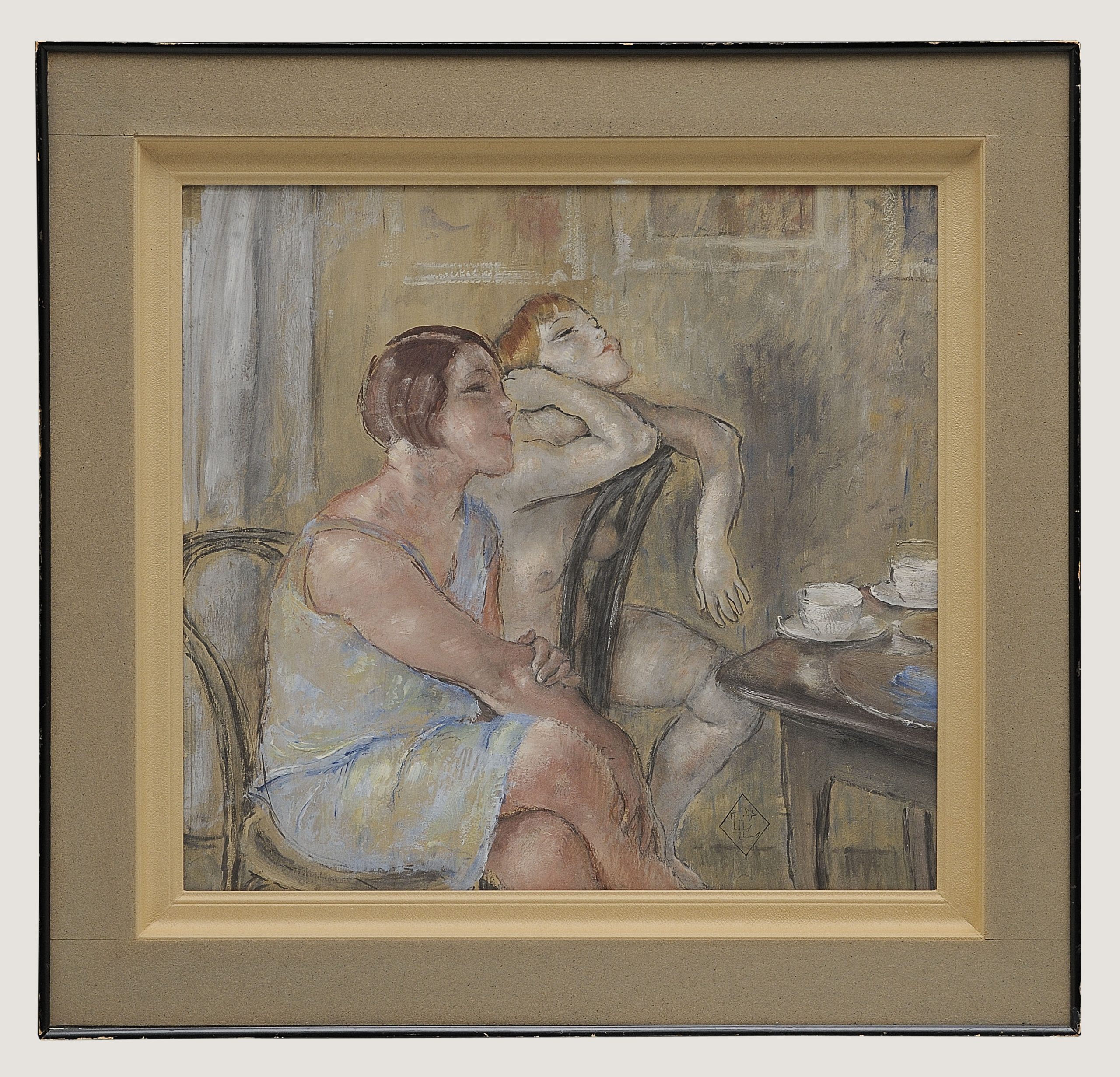
L’heure du thé
Oil on panel
Studio stamp in the lower right corner
Dimensions: 44 x 47 cm,
With frame: 60 x 64 cm
Gilberte Cournand collection (label on the back of the painting)
Price: 18,000 euro
The interior is modest, three paintings are hung on the wall, a curtain is stretched in the background. The women are seated on Thonet 14 chairs, at the time sold for the price of a bottle of table wine.
The nudity of the young woman in the background and the palette placed next to the cups show that the painter offers tea to his models after or before a posing session. The painting translates the love of life and of women. The scene is imbued with veracity and the sweetness of the anecdote.
Biography :
Louis Legrand was born in 1963 in Dijon. A painter, watercolorist, printmaker, and illustrator, he is a multifaceted artist. After studying at the École des Beaux-Arts in Dijon, he moved to Paris in 1884 and became a student of the brilliant and controversial Félicien Rops, who introduced him to various techniques, including engraving.
The master appreciates his student’s talents. In a letter dated 1888 from Félicien Rops to Mr. Roques, editor of the weekly newspaper *Le Courrier Français*, he refers to “the precious and rare qualities, dominated by an extraordinary love of form, of Louis Legrand.” ” He also writes, “You can imagine that it never occurred to me to teach that young man anything! Legrand set out on his own, just as ducklings head for the pond, to create beautiful drawings that caught the attention of artists and art lovers.”
From 1902, the artist participated in the Salons des Beaux Arts in Paris, at the Universal Exhibition of 1900 where he won a medal.
He also exhibited at the Samuel Bing Gallery and, in 1904, at the Georges Petit Gallery. He was awarded the Legion of Honor in 1906.
In 1911, the Durand-Ruel Gallery presented a major retrospective of his work.
Before Toulouse-Lautrec, he depicted Parisian nightlife during the Belle Époque—the bustling cafés, the women, and the can-can dancers. The Moulin Rouge in Paris served as the artist’s studio for many years.
The publisher and art collector Gustave Pellet published 300 of his engravings and purchased all of his pastels. He also engraved erotic subjects for Pellet. He was the painter of “gay eroticism.”
It is present in many private collections.
Bibliographie :
• Camille Mauclair, Louis Legrand, painter and engraver, Floury, Paris 1910
• Dictionary of illustrators-1800-1914, Idé and Calande, Neufchatel, Paris 1989
• Bénézit, “Louis Legrand”, Oxford Art Online
Museums:
. In France:
Dijon: the Magnin National Museum and the Museum of Fine Arts; Strasbourg: the Museum of Modern and Contemporary Art; Quimper: the Museum of Fine Arts.
. In Switzerland:
Geneva, Petit Palais.
. In the U.S.:
Cleveland, Museum of Art; San Francisco; Washington, Smithsonian American Museum

