
Eugène Gen Paul
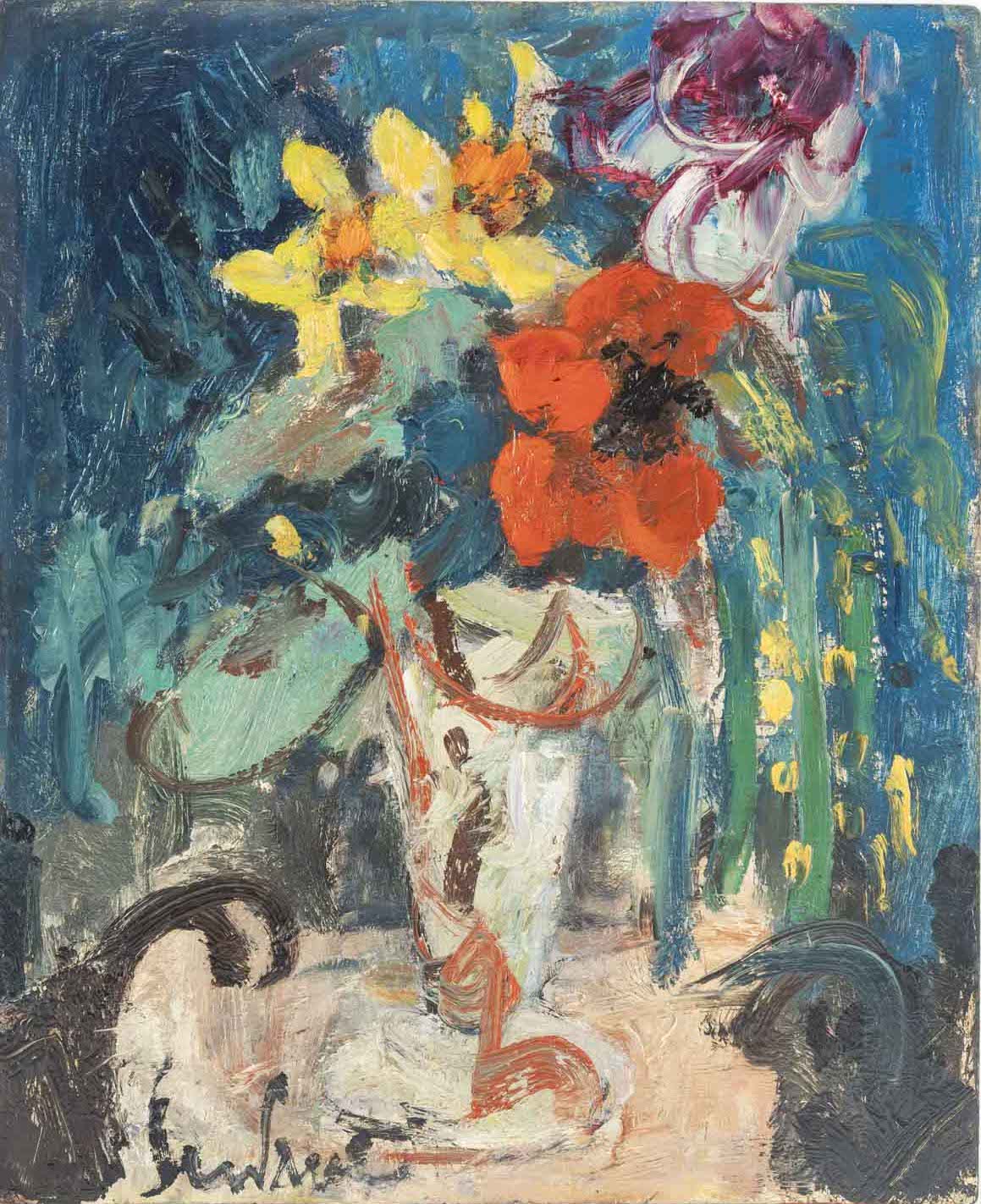
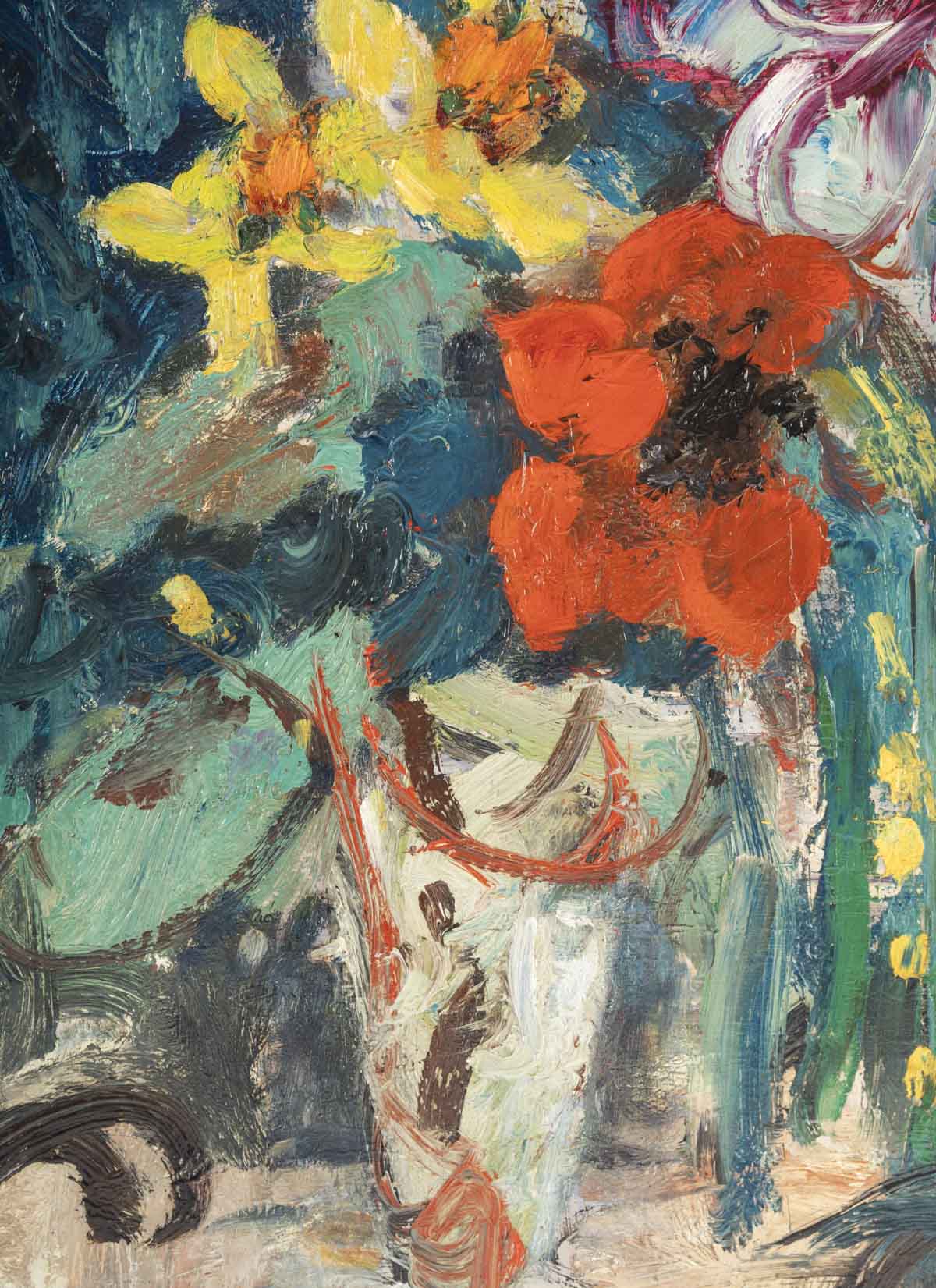
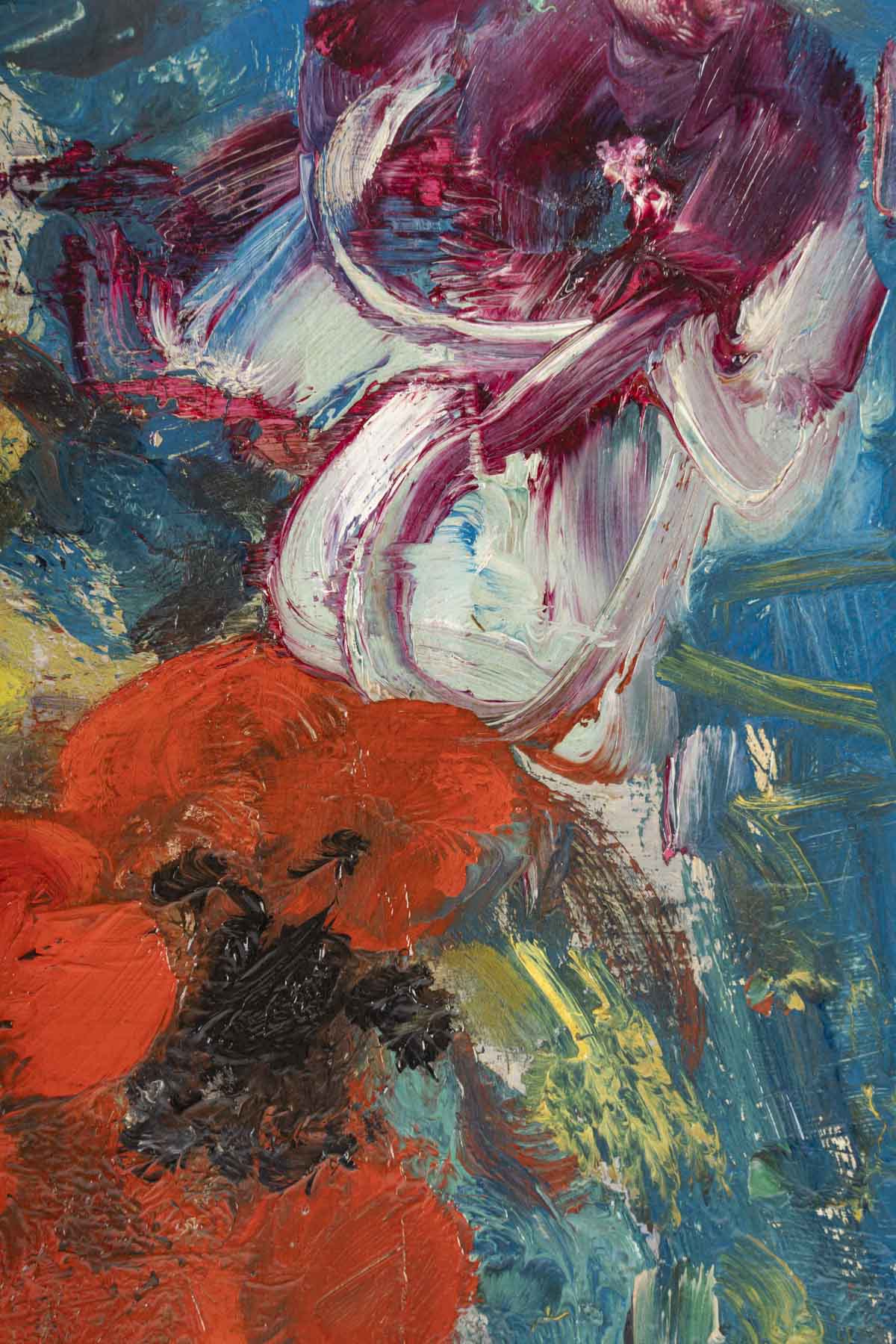
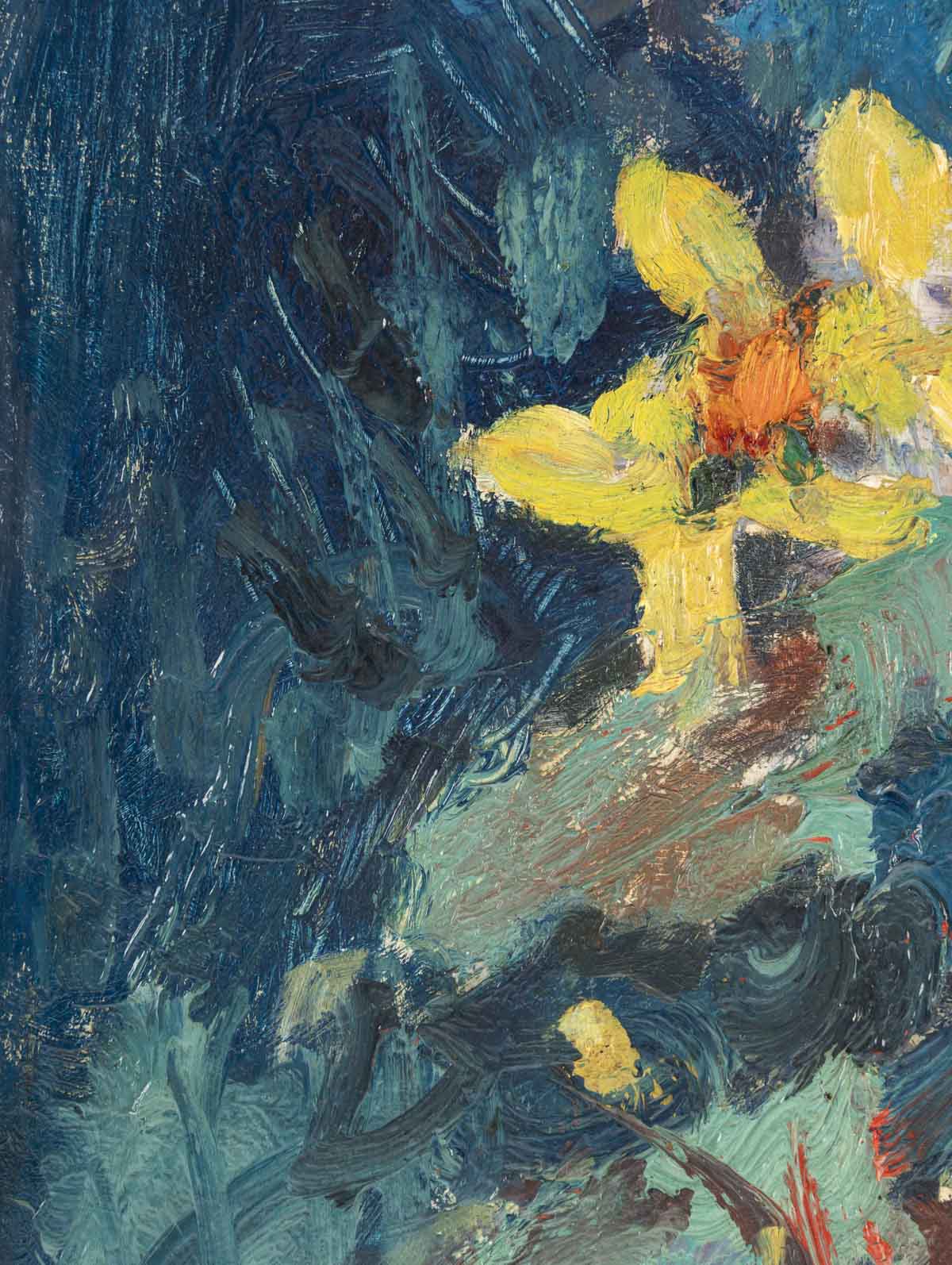
A bouquet of flowers by Gen Paul, 1925-1930. A cheerful, expressionist work, with bright colors and a lively touch.
Oil on mahogany panel
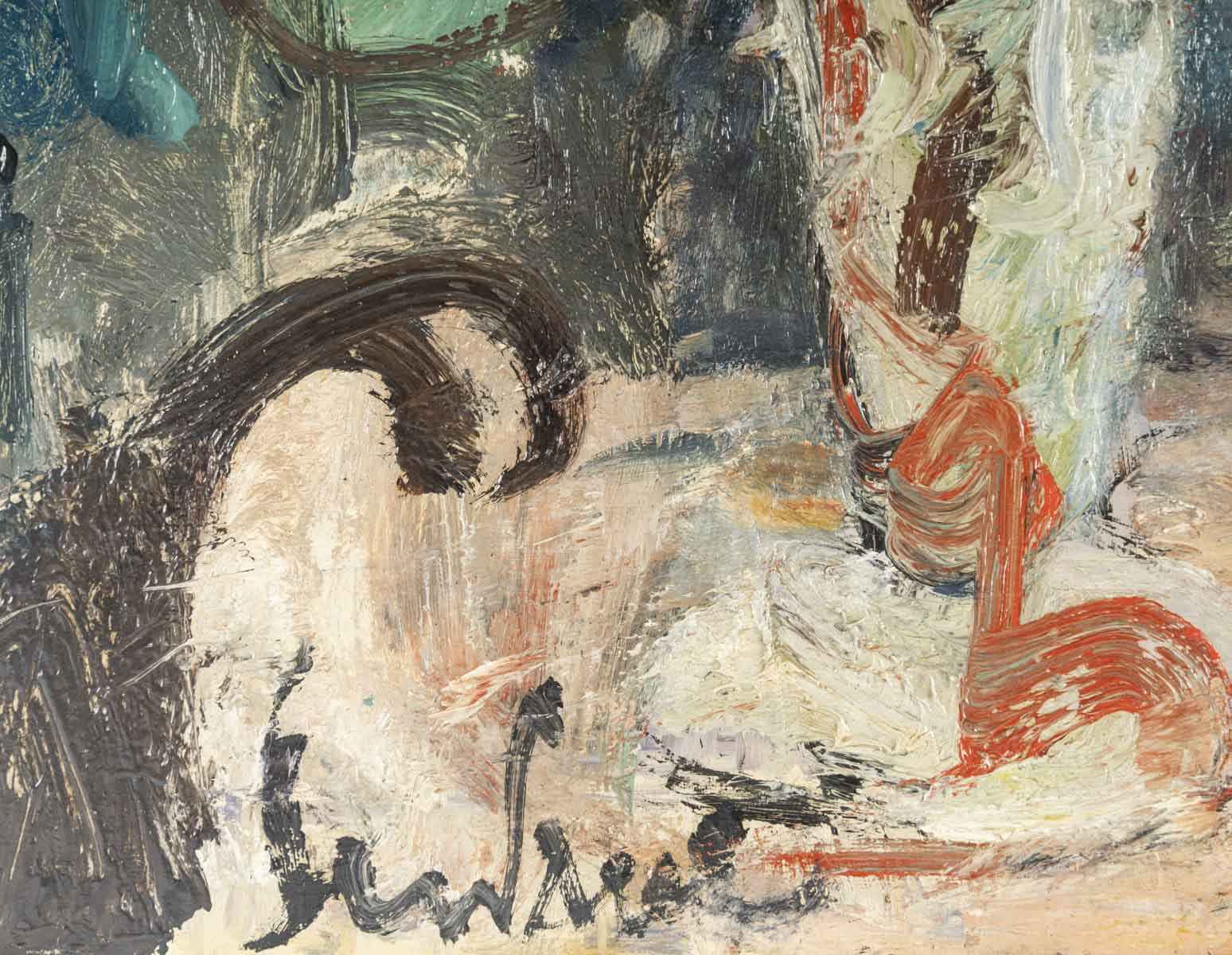
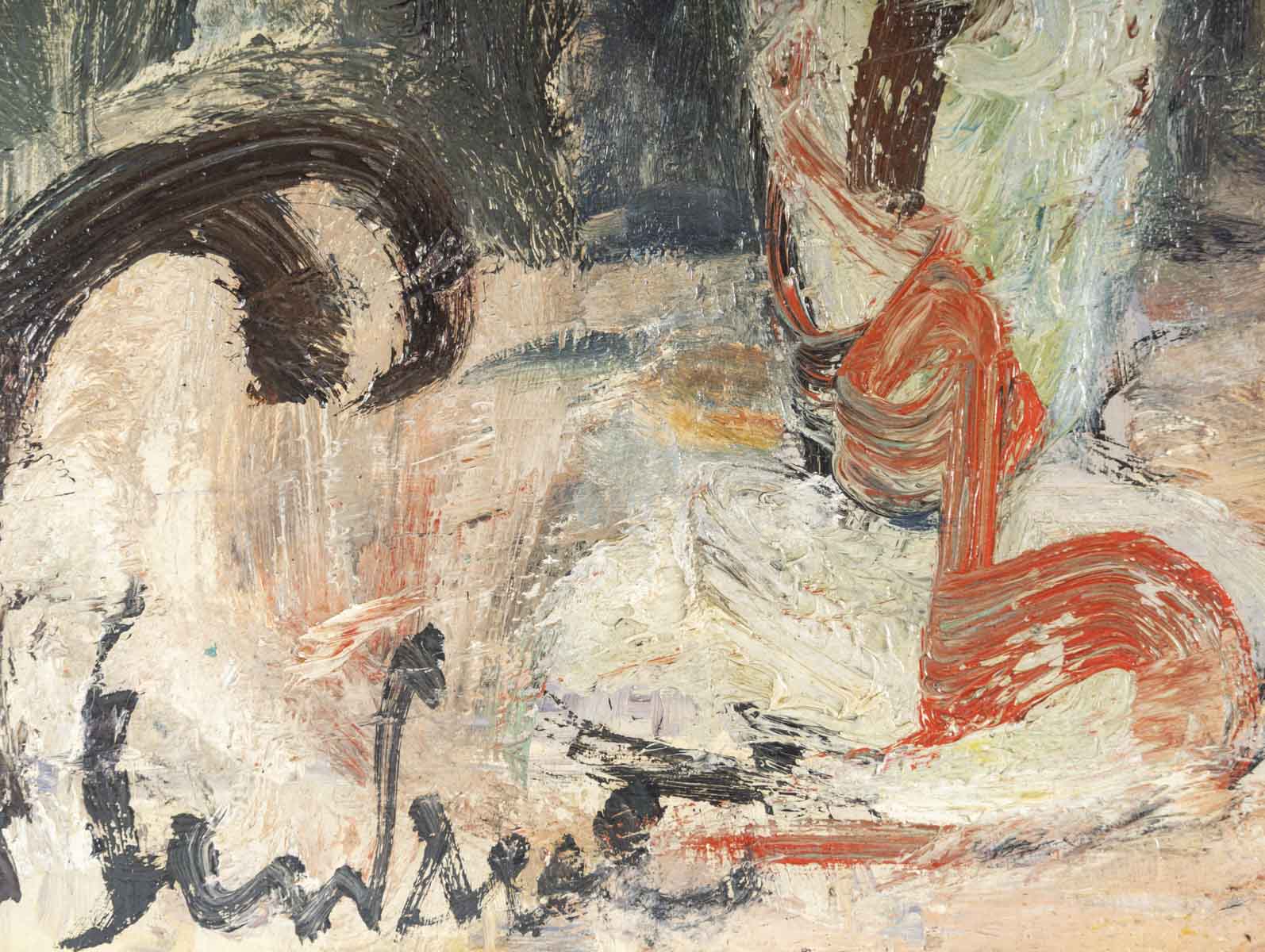
Signed lower left
Dimensions: 46 x 37.5 cm
Sold
Gen Paul the expressionism of 1925-1930 or the art of suggestion.
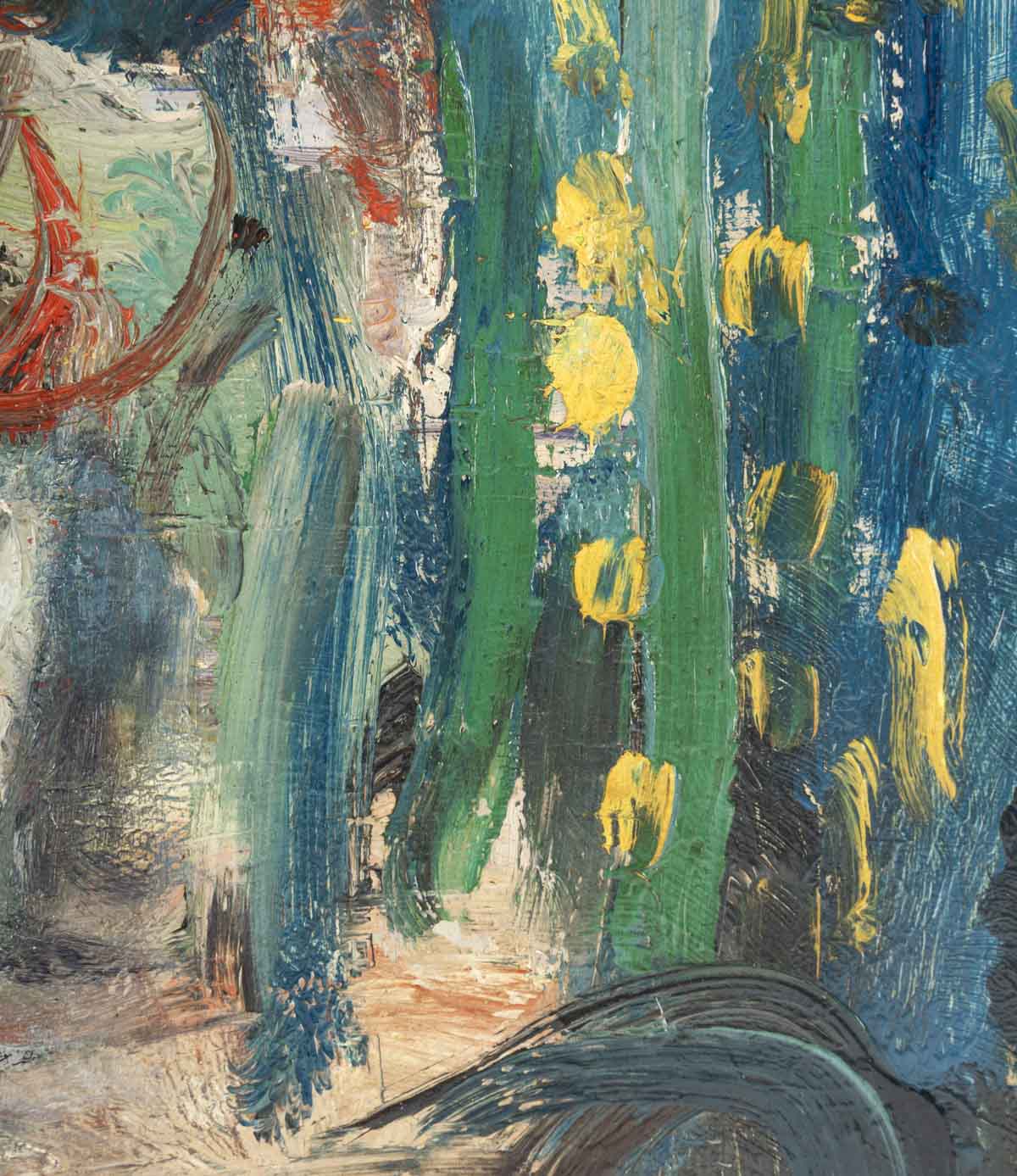
The bouquet is shown in front of a curtain of greenery. The decorated vase rests on a small pedestal table. We can make out the tops of two black chairs with rounded bistro-style backs surrounding the small table.
As usual with Gen Paul, the painting is not easy to read, the expressionism of his touch blurring the lines and heckling definition.
Between abstraction and figuration, in the 20s, Gen Paul, full of gaiety, painted above all what he loved.
Gen Paul, eager for life and movement, snatches up a colorful bouquet and throws it wildly onto his canvas in a joyful, orderly mess.
Biography
Gen Paul was born at 96, rue Lepic, in a house that Van Gogh depicted in one of his paintings. His mother was an embroiderer and his father a café musician. Being born on rue Lepic was a good sign, and GEN PAUL hasn’t changed neighborhoods since.
Memories fill his eyes, his head and his palette. When he left the communal school on rue Lepic in the evening, he was already fascinated by this strange, elegant, wonderfully-dressed dwarf who had his studio nearby, on rue Tourlaque: Toulouse Lautrec. He knew the Bonnot gang, La Goulue and carts.
A painter born in Montmartre and living in Montmartre is first and foremost a painter, and Gen Paul didn’t spend his life painting the Sacré Coeur, the Moulin Rouge and rue Lepic.
He began painting at an early age.
His apprenticeship was an original one: as an apprentice interior decorator, he looked around him in rich apartments. Passionate about painting and eager for knowledge, he observed the works collected by art lovers, wherever his work took him.
He completed his training during the few years he spent at the École des Beaux-Arts in Paris.
In 1913, he volunteered for the front and was wounded. A year later, a second injury led to the amputation of his right leg. Returning to Paris in 1916, he began painting.
His first oil painting – the Moulin de la Galette seen from his window – dates from 1916. Eugène Paul began his career as a painter. He painted many views of Paris to satisfy demand.
He signed his first canvas “GEN-PAUL” in 1918.
In 1920, he exhibited at the Salon d’Automne, and remained faithful to this institution, as well as to the Salon des Indépendants. He travels to Spain and is confronted with the masterpieces of the masters: Goya, El Greco, Velasquez… On his return, he makes even greater use of black in his compositions.
His first solo exhibition took place at Galerie Bing in 1926. He illustrated several of Céline’s books, including Voyage au bout de la nuit and Mort au crédit in 1942. He made engravings, some of which were published in a collection entitled Vues de Montmartre. At the end of the Second World War, he made frequent trips to the United States and New York. At the time, he held the rank of general. In 1952, the Drouant-David gallery in Paris devoted a retrospective to him. Apart from the annual events of the Paris art scene (the Salons), Gen Paul exhibited only exceptionally.
Unaffected by success and fame, he never took a painting to a dealer. They’re the ones who came to get them. the artist refuses to depend on any gallery. At the end of his life, he traveled frequently in France and Spain.
Bibliography
– Francis Carco, Gen Paul, Éditions de la Galerie Drouant-David, 1952.
– Raymond Nacenta, The School of Paris – The painters and the artistic climate of Paris since 1910, Osbourne Press, London, 1960.
– François Gibault, Céline, cavalier de l’apocalypse (1944-1961), Mercure de France, 1961.
– Jean-Paul Crespelle, Montmartre vivant, Hachette, 1964. See chapter 8 (pp. 224-247): “Gen Paul, de la rue Lepic”.
– Les Muses – Encyclopédie des arts, Éditions Grange Balelière, 1972.
– Pierre Davaine (preface by Jean Miller), Gen Paul, Éditions I.G.E., 1974.
– Emmanuel David (interviews with Herve Le Boterf), Le métier de marchand de tableaux, Éditions France-Empire, 1978.
– Carlo a Marca (preface by Marc-Édouard Nabe), Gen Paul, Transédition, 1986.
– Gabrielle Aber-Gen Paul, Guy Vignoht (“La Force de l’instinct d’un géant de l’expressionnisme”),
– Jeanine Warnod, Gen Paul, 1895-1975, exhibition catalog, Palais des Beaux-Arts, Menton, 1993.
– Chantal Le Bobinnec, Gen Paul à Montmartre, Éditions Chalmin et Perrin, 1995.
– André Roussard and Carlo a Marca, Catalogue of the Gen Paul exhibition, Couvent des Cordeliers, 1995.
– Gérald Schurr, Le Guidargus de la peinture, Les Éditions de l’Amateur, 1996.
– Carlo a Marca, Joann a Marca, Gabrielle Aber-Gen Paul , Gen Paul (1895-1975), published by Hotel Splügenschloss, Zurich, 1998.
– André Roussard, Gen Paul. La biographie, Éditions André Roussard, 2006, 304 p.
– Jacques Lambert (preface by Claude Duneton), Gen Paul : Un peintre maudit parmi les siens, La Table Ronde, 2007
– Chantal Le Boubinnec (presentation by Claude Duneton), Gen Paul à Montmartre, Les éditions de Paris – Max Chaleil, 2007
– Francesco Rapazzini, Le Moulin Rouge en folies – Quand le cabaret le plus célèbre du monde inspire les artistes, Le Cherche Midi, 2016.
– Marie-France Coquard, “Gen Paul et Jean-Pierre Serrier, deux potes de Montmartre”, Revue Paris Montmartre.

